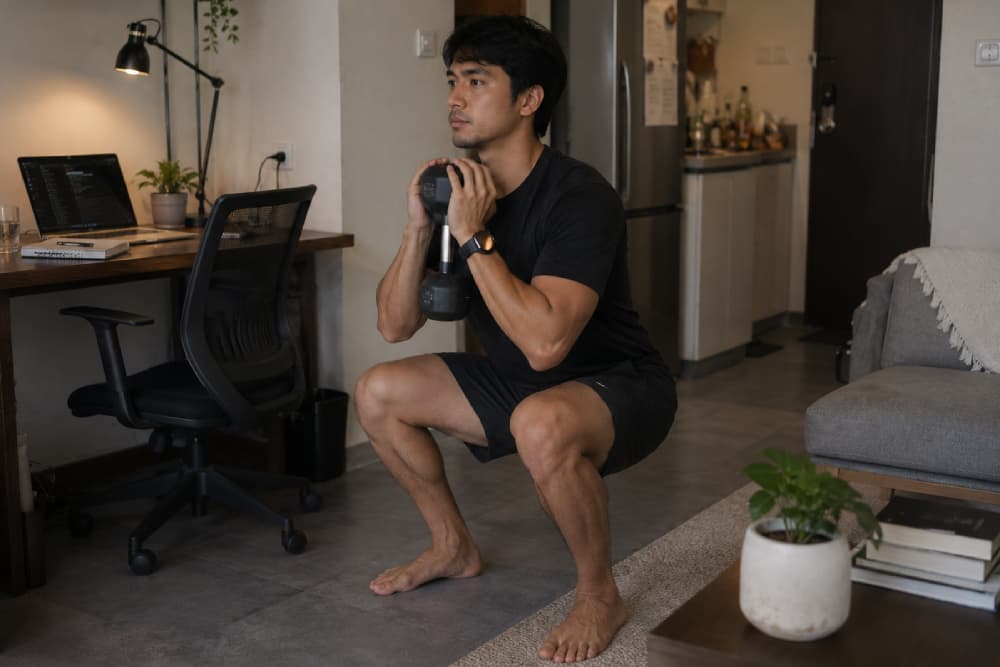
New city, new gym you’ve never set foot in, jet lag still lingering, and a workout window that’s shrinking fast. This is the exact scenario where most people skip leg day entirely. The goblet squat is the exercise that removes every excuse.
Why “No Gym, No Time, No Equipment” Stops Being an Excuse
Ask anyone with an unpredictable schedule what derails their fitness consistency and the answers are almost always the same: unfamiliar gyms, unpredictable schedules, limited equipment, and bodies that are still adjusting to a new timezone or a rough night’s sleep. Lower body training is usually the first thing to get cut — because exercises like barbell squats and leg presses require specific machines that aren’t always available.
The goblet squat solves this entire category of problems. It requires nothing more than a single dumbbell, kettlebell, or even a heavy water jug — something nearly every gym, hotel room, or Airbnb has in some form. It also happens to be one of the most biomechanically forgiving squat variations that exists, making it ideal for anyone training in unfamiliar environments without a coach to check their form.
If barbell squats are intimidating and leg press machines aren’t always accessible, the goblet squat is the bridge — accessible enough for beginners, effective enough that advanced lifters still use it as a primary strength-building tool.
For a complete training framework before diving into individual exercises, check out our fitness routine guide for digital nomads in Canggu, Bali.
What Makes the Goblet Squat Different
A goblet squat is performed by holding a single weight — typically a dumbbell or kettlebell — vertically against your chest with both hands, then squatting down between your legs.
That single detail — holding the weight at your chest, rather than on your back (barbell squat) or pressing it from a seated position (leg press) — changes the entire mechanics of the movement in ways that matter enormously when you can’t count on the same gym twice.
It Forces an Upright Torso
Because the weight is held in front of your chest, your torso is naturally pulled into a more vertical position throughout the squat. This is the opposite of what happens with a barbell back squat, where the weight on your upper back tends to pull you into a forward lean if your form breaks down.
For people who spend their days hunched over a laptop, this upright-torso requirement is doing double duty — it’s not just building leg strength, it’s actively retraining the postural pattern that desk work destroys.
It Naturally Improves Depth and Mobility
Holding the weight at your chest acts as a counterbalance, making it easier to squat to full depth (hips below knee level) without losing balance or falling backward — a common issue for beginners attempting bodyweight squats or barbell squats. This means the goblet squat doubles as a mobility tool, gradually improving hip and ankle flexibility through repeated full-range repetitions.
It’s Self-Correcting
If your knees cave inward, the weight pulls you off balance immediately — giving you instant feedback. This built-in feedback loop is part of why coaches use the goblet squat as a teaching tool for the squat pattern itself, before progressing lifters to barbell variations.
The Muscles Doing the Work
Quadriceps. The primary movers throughout the squat, particularly through the bottom-to-mid range. The upright torso position of the goblet squat places slightly more demand on the quads compared to a back squat, where torso lean shifts some load to the posterior chain.
Glutes. Heavily engaged, especially as you drive up out of the bottom position. Strong glutes are critical for anyone who sits most of the day, because prolonged sitting causes “gluteal amnesia” — a documented phenomenon where the glute muscles become inhibited and underactive from disuse. Pairing goblet squats with a Romanian deadlift on leg day builds glute strength from both the front and back of the movement.
Adductors (Inner Thigh). The wide stance typically used in goblet squats — feet slightly wider than shoulder-width, toes turned out — recruits the inner thigh muscles more than a narrower-stance squat. This is an often-neglected muscle group that contributes to hip stability.
Core and Upper Back. Holding a weight against your chest for an entire set isn’t just a leg exercise — it’s an isometric core and upper-back challenge. Your abs, obliques, and upper back muscles work continuously to keep the weight stable and your spine neutral.
A 2015 biomechanics study published in the Journal of Strength and Conditioning Research found that goblet squats produced trunk muscle activation comparable to many dedicated core exercises — a useful bonus for anyone whose ab routine consists mostly of intentions.
How to Perform the Goblet Squat Correctly
Setup
Hold a dumbbell or kettlebell vertically against your chest, cupping the top of it with both hands — like holding a heavy goblet (hence the name). Elbows point down and in, tucked close to your ribs. Stand with feet slightly wider than shoulder-width, toes turned out roughly 15–30 degrees.
The Descent
Initiate the movement by pushing your hips back slightly and bending your knees. Keep your chest up and your weight centered over your midfoot — not your toes. Descend until your elbows touch the inside of your knees, or as close to that position as your mobility allows. Your torso should remain relatively upright throughout — this is the key differentiator from a back squat.
The Bottom Position
At the bottom, your hips should be at or below knee level for a full range of motion. Briefly pause here — this isn’t a bounce-and-go movement. Use the pause to confirm your knees are tracking over your toes, not collapsing inward.
The Ascent
Drive through your full foot — heels and midfoot, not just your toes — to stand back up. Squeeze your glutes at the top. Avoid letting your knees lock out aggressively; finish the rep with a slight, controlled extension.
Breathing
Inhale as you descend, brace your core at the bottom, exhale as you drive up through the hardest part of the rep.
Common Mistakes — and How to Fix Them
Heels Lifting Off the Ground. This usually indicates limited ankle mobility. Fix: widen your stance slightly, turn your toes out more, or elevate your heels on a small wedge or weight plates until mobility improves.
Knees Caving Inward. A sign of weak glute medius or poor movement awareness. Fix: actively think “push your knees out” throughout the descent, and consider adding a resistance band around your knees during warm-up sets to build the cue.
Rounding the Upper Back. Often caused by holding the weight too low or too far from the chest. Fix: pull the weight in tight against your sternum, elbows pointing down rather than out.
Rushing the Bottom Position. Bouncing out of the bottom reduces muscle tension and increases joint stress. Fix: pause for a full second at the bottom of every rep before driving up.
Going Too Heavy Too Soon. The goblet squat’s accessibility tempts people to load it up quickly. But once the weight becomes too heavy to hold comfortably at your chest, your form degrades fast. Fix: prioritize a weight that allows full depth and a controlled tempo over raw load.
Training Program: Three Phases
Phase 1: Foundation (Weeks 1–4)
Goal: Build the squat pattern, improve mobility
- Frequency: 2x per week
- Sets: 3
- Reps: 12–15
- Tempo: 3 seconds down, 1 second pause, 2 seconds up
- Load: Light — a 6–10kg dumbbell or kettlebell is plenty to start
- Rest: 60–90 seconds between sets
Focus: Full depth with control over speed or weight. If you can’t reach full depth with good form, this phase is doing exactly what it’s supposed to do.
Phase 2: Strength Building (Weeks 5–12)
Goal: Progressive overload, build real lower body strength
- Frequency: 2x per week
- Sets: 4
- Reps: 8–12
- Tempo: 3 seconds down, 1 second pause, explosive up
- Load: Increase by 2–4kg every 2 weeks once all reps are completed with full depth and clean form
- Rest: 90 seconds–2 minutes between sets
Phase 3: Travel Maintenance (Anytime)
Goal: Maintain strength when equipment access is unpredictable
- Sets: 3
- Reps: 15–20
- Load: Whatever is available — a backpack loaded with books works in a pinch
- Rest: 60 seconds
The beauty of this phase is its flexibility: a 15-minute goblet squat session with nothing but a backpack is enough to maintain meaningful strength during weeks of unpredictable travel.
Fitting Goblet Squats Into a Full Weekly Routine
The goblet squat works exceptionally well as either a standalone leg day movement or a warm-up/activation exercise before heavier lifts like the leg press or barbell squat.
Sample weekly structure:
| Day | Session |
|---|---|
| Monday | Push (Bench Press + Overhead Press + Triceps) |
| Wednesday | Pull (Barbell Row + Lat Pulldown + Bicep Curls) |
| Friday | Legs (Goblet Squat + Leg Press + Romanian Deadlift) |
When pairing the goblet squat with the leg press in the same session, perform the goblet squat first as a compound movement that demands more coordination and core stability while you’re fresh, then move to the leg press for higher-load, lower-coordination volume work. Our complete leg press guide covers the full protocol for that pairing.
Frequency
1–2x per week is sufficient for most people, particularly when combined with daily walking, which many people accumulate naturally while commuting or exploring a new city.
Nutrition Notes for Lower Body Development
Protein. As with any resistance training, muscle adaptation depends on adequate protein intake. Target 1.6–2.0g per kg of body weight daily, the range supported by a 2018 meta-analysis in the British Journal of Sports Medicine.
Magnesium and Hydration. Squatting heavily and traveling frequently both increase demand on electrolyte balance. Magnesium deficiency is linked to muscle cramping and slower recovery — particularly relevant in hot, humid climates common to travel hubs like Bali, Chiang Mai, and Medellín. Leafy greens, nuts, and dark chocolate are practical travel-friendly sources.
Carbohydrates for Leg Day. Lower body training is metabolically demanding. A small carbohydrate-containing meal 60–90 minutes before training — rice, fruit, oats — improves performance output during higher-rep leg sessions.
What Changes After 6–8 Weeks
Stick with a consistent goblet squat practice and you’ll likely notice:
- Improved hip and ankle mobility — the repeated full-depth squatting gradually increases range of motion, which carries over into daily movement and reduces stiffness from sitting
- Stronger, more stable knees — the self-correcting nature of the movement builds knee tracking patterns that reduce injury risk in other activities, including hiking and trekking
- Better posture awareness — the upright-torso requirement trains postural habits that start to carry over into how you sit and stand throughout the day
- Increased confidence in unfamiliar gyms — once you’ve mastered the goblet squat pattern, walking into any new gym anywhere in the world and getting an effective leg workout becomes simple
Closing: The Squat That Travels as Well as You Do
Consistent fitness often fails not because of a lack of motivation, but because of friction — unfamiliar equipment, inconsistent access, mental energy spent figuring out a new gym instead of just training. The goblet squat removes nearly all of that friction.
One dumbbell. One kettlebell. A backpack, if that’s all you have. A movement pattern simple enough to execute correctly in your first attempt, yet effective enough that strength coaches still program it for advanced athletes.
For a life defined by constant change — whether that’s a new city every month or just a packed, unpredictable week — the goblet squat is one of the few exercises that stays exactly as effective no matter where in the world you happen to be standing.
If you’re in Canggu and want a gym in Canggu stocked with dumbbells and kettlebells ready to go, Avenue Fitness Bali is a solid option.
This article is for informational purposes only and does not replace professional medical advice. If you have a history of knee, hip, or lower back injuries, consult a physiotherapist before beginning any new training program.