You’ve been staring at a screen all day, shoulders creeping forward, upper back slowly rounding. You’ve heard “sit up straight” a thousand times. It doesn’t work — not because you lack discipline, but because the muscles responsible for holding you upright have quietly stopped doing their job.
The Back Problem That Remote Work Creates — And Almost Nobody Addresses
Posture isn’t just about habit. It’s about strength.
When people talk about “bad posture” in remote workers, they almost always frame it as a behavioral problem — you need to sit differently, set a timer, buy a better chair. What rarely gets discussed is the underlying muscular reality: prolonged laptop use systematically weakens the entire posterior chain of your upper body while simultaneously tightening the anterior muscles.
Here’s what’s actually happening in your body right now if you’ve been working remotely for any length of time:
- Rhomboids and mid-trapezius are chronically lengthened and weak — these muscles are supposed to retract your shoulder blades and keep them anchored. Sitting with arms forward all day stretches them beyond their working range and they gradually lose the ability to generate force.
- Lower trapezius is inhibited — responsible for depressing and stabilizing the scapula, the lower trap becomes underactive in people with desk posture, contributing to shoulder impingement and neck tension.
- Latissimus dorsi are underdeveloped — the largest muscle in your back, the lats provide the structural width and pulling strength that keeps your torso stable during any overhead or carrying task.
- Thoracic spine loses extension mobility — the mid-back stiffens into flexion, making it physically harder to sit upright even when you’re trying.
No ergonomic chair fixes this. No posture reminder app fixes this. Strengthening these muscles fixes this — and the barbell row is one of the single most effective exercises for doing exactly that.
If you’re starting from scratch with your fitness routine, our complete fitness routine guide for digital nomads in Canggu, Bali gives you the full framework before diving into individual movements.
Why the Barbell Row Specifically?
There are plenty of rowing movements — cable rows, dumbbell rows, machine rows, TRX rows. All of them have merit. But the barbell row offers something the others don’t: the ability to load the entire posterior chain simultaneously under heavy, progressive resistance.
A 2014 study in the Journal of Strength and Conditioning Research comparing upper body pulling variations found that the bent-over barbell row produced the highest overall muscle activation across the latissimus dorsi, rhomboids, trapezius, and rear deltoids — outperforming both cable and machine rowing variations.
The reason comes down to physics. Because you’re holding a barbell in a hip-hinged position with no external support, every muscle from your hamstrings to your upper back is working simultaneously — to maintain the position, stabilize the spine, and execute the pull. It’s a full posterior chain event disguised as a back exercise.
| Factor | Barbell Row | Cable Row | Dumbbell Row | Machine Row |
|---|---|---|---|---|
| Overall muscle activation | Highest | High | High | Moderate |
| Progressive overload potential | Excellent | Good | Good | Limited |
| Core and posterior chain demand | Very high | Low | Moderate | None |
| Equipment availability | High — most gyms | High | High | Moderate |
| Technical demand | Moderate | Low | Low | Low |
Anatomy: Every Muscle That Works During a Barbell Row
Latissimus Dorsi
The primary mover. This broad, wing-shaped muscle runs from your lower spine and pelvis up to your upper arm. Pulling exercises develop the lats more than almost anything else, and strong lats are directly linked to shoulder stability, pulling capacity, and the visual “V-taper” that distinguishes a trained back from an untrained one.
Rhomboids
Located between your shoulder blades, the rhomboids retract the scapulae — pulling them together toward the spine. This is the exact motion that counteracts the forward-shoulder collapse of desk posture. Direct, heavy rhomboid training is one of the few things that genuinely reverses postural deterioration over time.
Trapezius (Middle and Lower)
The trapezius has three regions. The middle trap assists scapular retraction alongside the rhomboids. The lower trap depresses the scapula — critical for preventing shoulder impingement during overhead movements. Both are heavily recruited during barbell rows.
Rear Deltoids
The posterior head of the deltoid assists in shoulder extension and external rotation — movements that directly oppose the internal rotation caused by chronic desk posture. Stronger rear delts mean shoulders that naturally sit further back, even when you’re not actively thinking about posture.
Erector Spinae
The muscles running along either side of your spine work isometrically throughout the entire set to maintain the hip-hinged position. This makes the barbell row a significant lower back and spinal stabilizer workout as well.
Biceps and Forearms
Assist in elbow flexion during the pull. This is why pulling training and bicep training pair so naturally — you’re getting meaningful bicep stimulus as a byproduct of rowing.
Technique: The Complete Breakdown
The barbell row has more technical nuance than it appears. Most people perform it with too much weight, too much body swing, and too little range of motion — getting a fraction of the benefit while accumulating injury risk.
Setup
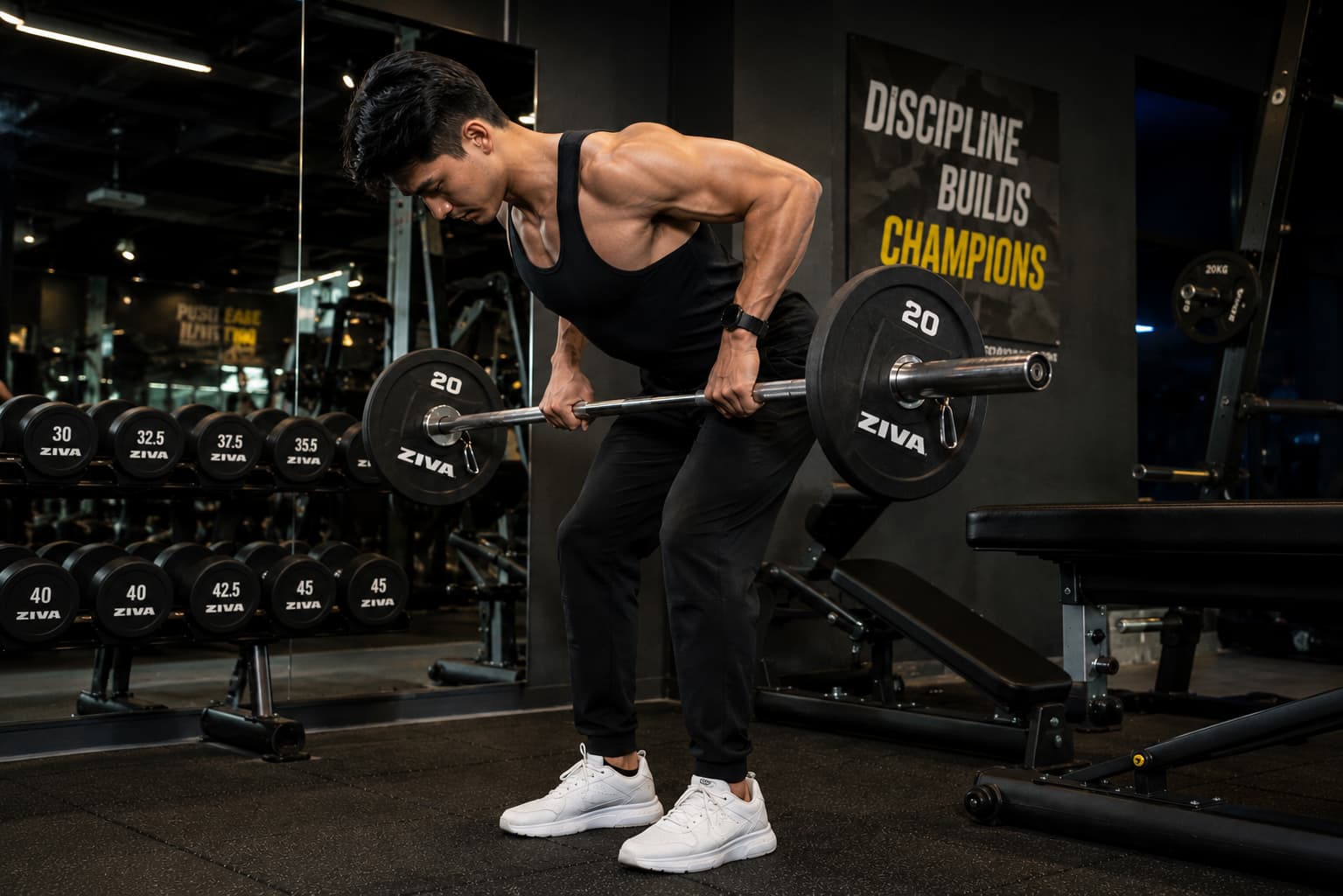
Bar position: Load the bar on the floor or in a rack. Stand with feet hip-width apart, bar directly over your midfoot.
Hip hinge: Push your hips back and bend your knees slightly until your torso is at roughly 45–60 degrees to the floor. Some lifters prefer a more horizontal torso (closer to parallel with the floor) for greater lat recruitment. Either angle works — choose based on what allows you to maintain a neutral spine without strain.
Grip: Overhand (pronated) grip, hands slightly wider than shoulder-width. This is the standard rowing grip and maximizes rhomboid and mid-trap involvement. Underhand (supinated) grip shifts more load to the biceps and lower lats — a useful variation once you’ve mastered the standard.
Spine: Neutral throughout — natural curves preserved. Not hyperextended, not rounded. The moment your lower back rounds under load is the moment you stop the set.
The Pull
Drive your elbows back and upward — think “elbows to the ceiling behind you” rather than “pull the bar to your body.” This cue promotes scapular retraction and keeps the elbows from flaring wide.
Pull the bar to your lower sternum or upper abdomen — not to your chest. Pulling too high (toward the chest) shifts the movement into a rear delt exercise and reduces lat involvement.
At the top of the movement, squeeze your shoulder blades together actively for one full second. This isometric contraction at the peak is where the postural benefit is most directly trained.
The Lowering Phase
Lower the bar slowly — 2 to 3 seconds — maintaining your hip hinge position. Allow a slight forward reach of the shoulder blades at the bottom to get a full stretch of the lats and rhomboids before initiating the next rep. This full range of motion is what separates effective rowing from partial-rep weight swinging.
Breathing
Inhale and brace your core before each rep. Exhale as you complete the pull. For heavier sets, use a Valsalva maneuver — fill your belly with air and hold it through the rep — to maximize spinal stability.
Common Mistakes
Excessive Body Swing
Using momentum by jerking the torso upright turns the barbell row into a partial deadlift and removes tension from the back entirely.
Fix: Film yourself from the side occasionally. Your torso angle should remain consistent throughout the set. If it’s changing, the weight is too heavy.
Pulling to the Chest Instead of the Abdomen
Pulling the bar too high reduces lat activation and turns the movement into a high pull, which is a different exercise entirely.
Fix: Aim for the lower sternum or belly button region, depending on your torso angle.
Not Retracting the Scapulae
Rowing without actively squeezing the shoulder blades is like doing a bicep curl without bending your elbow fully — you’re missing the point of the exercise.
Fix: At the top of every rep, consciously pull your shoulder blades together and hold for one second before lowering.
Rounding the Lower Back
The most common injury risk in the barbell row. Usually caused by too much weight, too little hamstring flexibility, or both.
Fix: Reduce the weight until you can maintain a neutral spine for every rep of every set. Alternatively, elevate the bar by performing Romanian deadlifts with the bar set higher, or switch temporarily to dumbbell rows with one hand supported on a bench.
Barbell Row Variations
1. Overhand Barbell Row (Standard)
The baseline. Maximum posterior chain involvement, highest strength carryover. Start here.
2. Underhand Barbell Row (Supinated Grip)
Rotating your grip so palms face upward shifts emphasis to the lower lats and biceps. Many lifters find this variation allows a more natural elbow path and better lat stretch at the bottom.
Best for: Lower lat development, variation after mastering the standard.
3. Pendlay Row
A stricter variation where the bar returns to the floor between every rep, and the pull is initiated explosively from a dead stop. Eliminates all momentum, maximizes back activation per rep.
Best for: Intermediate to advanced lifters, developing explosive pulling power.
4. Dumbbell Row (Single Arm)
One knee and hand supported on a bench, row a single dumbbell with the other arm. Lower technical demand than the barbell version, easier to maintain neutral spine, excellent for addressing left-right strength imbalances.
Best for: Nomads training alone in unfamiliar gyms, beginners building toward the barbell version.
5. Cable Row
Seated at a cable machine, pull a handle toward your lower sternum. Provides constant tension throughout the range of motion, lower spinal loading than barbell rows.
Best for: High-volume accessory work, deload weeks, gyms without barbells.
Training Program: Three Phases
Phase 1: Foundation (Weeks 1–4)
Goal: Build the hip hinge pattern, develop scapular control
- Frequency: 2x per week
- Exercise 1: Dumbbell Row (single arm, bench supported) — 3 sets × 12 reps per side
- Exercise 2: Cable Row or Machine Row — 3 sets × 15 reps
- Tempo: 2 seconds up, 1 second squeeze, 3 seconds down
- Load: Light — prioritize feeling the back muscles work over moving weight
- Rest: 90 seconds between sets
Why start with dumbbells? The supported position removes spinal loading and lets you focus entirely on scapular retraction and lat engagement before adding the postural demands of the barbell version.
Phase 2: Strength Building (Weeks 5–12)
Goal: Progressive overload on the barbell row, build real pulling strength
- Frequency: 2x per week
- Exercise 1: Barbell Row (overhand) — 4 sets × 6–10 reps
- Exercise 2: Dumbbell Row — 3 sets × 10–12 reps per side
- Exercise 3: Face Pull or Rear Delt Flye — 3 sets × 15 reps
- Tempo: Controlled descent, explosive pull
- Load: Increase by 2.5–5kg every 2 weeks when all reps are completed with neutral spine and full scapular retraction
- Rest: 2–3 minutes between heavy barbell sets
Phase 3: Travel Maintenance (Anytime)
Goal: Preserve pulling strength during unpredictable travel periods
- Exercise 1: Dumbbell Row or Cable Row — 3 sets × 12 reps
- Exercise 2: Band Pull-Apart or Face Pull — 3 sets × 15 reps
- Rest: 60–90 seconds
Even one pulling session per week at moderate intensity is sufficient to prevent significant strength regression during extended travel.
Programming Into Your Full Weekly Routine
The Push-Pull Imperative
Every pushing movement you do — bench press, shoulder press, dips — needs to be balanced by an equal or greater volume of pulling. For digital nomads who are already in a “pushed forward” postural state from desk work, most coaches recommend slightly more pulling volume than pushing volume. A 1:1.5 ratio (push:pull) is a practical target.
Sample weekly structure:
| Day | Session |
|---|---|
| Monday | Push (Bench Press + Overhead Press + Triceps) |
| Wednesday | Pull (Barbell Row + Lat Pulldown + Bicep Curls) |
| Friday | Legs (Goblet Squat + Leg Press + Romanian Deadlift) |
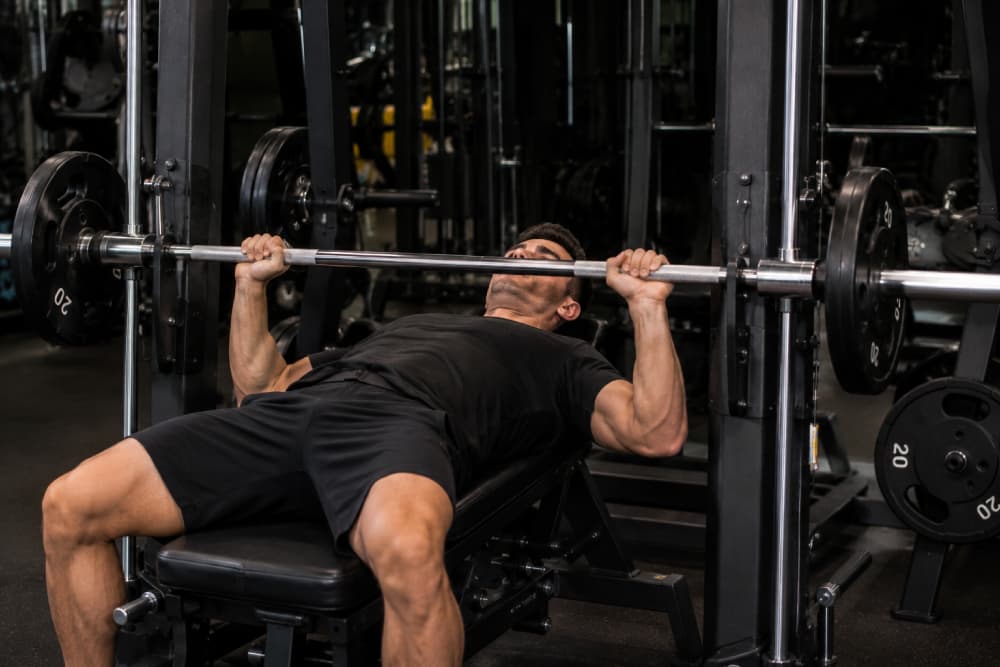
For your chest and pressing work, our bench press guide for digital nomads covers the full protocol. For legs, our leg press guide has everything you need.
What Changes After 8 Weeks
Consistent barbell rowing produces changes that go well beyond the gym:
- Shoulders naturally sit further back — the rhomboids and mid-traps are now strong enough to hold the scapulae in their correct position without conscious effort
- Neck tension decreases — much chronic neck tension in desk workers originates from the upper trapezius overcompensating for weak middle and lower trap. Strengthening the lower traps directly reduces this pattern
- Posture improves without thinking about it — this is the key distinction from behavioral posture fixes. When the muscles are strong enough, upright posture becomes the path of least resistance rather than an effort
- Overhead movements become easier — stronger lats and scapular stabilizers improve shoulder health across all planes, including reaching overhead during daily tasks
- Lower back feels more stable — the isometric spinal erector work across hundreds of weekly reps builds a resilience that carries directly into daily sitting and walking
Closing: The Exercise Your Back Has Been Waiting For
The digital nomad lifestyle asks a lot of your back. Hours of sitting, bags carried through airports, sleeping in different beds every few weeks, and a posture that slowly folds forward under the weight of a screen. Most people try to fix this with stretching, foam rolling, and good intentions.
The barbell row is a different kind of solution — not passive, not temporary. It builds the posterior chain strong enough to hold you upright even after a 10-hour work day. It reverses the muscular imbalances that laptop life creates. And it does it with a single piece of equipment available in every gym on earth.
Two sessions per week. Consistent progressive overload. A back that works as hard as you do — and holds up longer.
This article is for informational purposes only and does not replace professional medical advice. If you have a history of lower back, shoulder, or elbow injuries, consult a physiotherapist before beginning any new rowing program.