You’ve been hunched over a laptop for six hours straight. Your shoulders are rolled forward, your chest feels compressed, and your upper back is quietly screaming. Most nomads reach for a massage. The smarter fix? Get under a bar.
The Chest Problem That Desk Work Creates
There’s a postural pattern so common among remote workers it has an unofficial name: “desk posture.” Rounded shoulders, forward head, compressed chest, weakened upper back. It develops gradually — so gradually that most people don’t notice it until someone shows them a photo of themselves from the side.
Here’s what’s actually happening biomechanically:
- Pectorals shorten and tighten — hours of arms-forward typing keeps the chest muscles in a chronically contracted state, pulling the shoulders forward.
- Anterior deltoids become dominant — the front of your shoulders overworks to compensate for a weak, underused chest.
- Thoracic spine stiffens — reduced mobility in the mid-back makes it harder to sit upright, which accelerates the postural collapse.
- Serratus anterior weakens — a critical but overlooked muscle that keeps the shoulder blade anchored to the ribcage. Weakness here contributes directly to shoulder impingement.
The bench press — done correctly — addresses every single one of these issues. It strengthens the chest through a full range of motion, reactivates the serratus anterior, builds shoulder stability, and when combined with proper rowing movements, becomes one of the most effective postural correctors available to anyone sitting at a desk all day.
If you’re building your fitness routine from the ground up, start with our complete fitness routine guide for digital nomads in Canggu, Bali before diving into individual exercises.
Why the Bench Press — Not Push-Ups, Not Cable Flyes?
Push-ups are great. Cable flyes have their place. But the bench press offers something neither can fully replicate: progressive, measurable overload with full pectoral engagement.
The Case Against Relying on Push-Ups
Push-ups are bodyweight — meaning once you can do 20+ with good form, you’ve outpaced the stimulus. You can make them harder (elevated feet, weighted vest, archer push-ups), but the setup complexity increases significantly. The bench press allows you to add 2.5kg plates and continue progressing linearly for years.
Why the Bench Press Wins for Nomads
A study in the Journal of Human Kinetics (2020) compared muscle activation across common chest exercises and found that the barbell bench press produced the highest overall pectoralis major activation — particularly in the sternal (lower) portion, which is the largest section of the chest and the hardest to develop with bodyweight movements alone.
| Factor | Bench Press | Push-Ups | Cable Flye |
|---|---|---|---|
| Progressive overload | Easy and linear | Limited without extra equipment | Moderate |
| Equipment availability | High — every gym has one | None needed | Requires cable machine |
| Muscle activation | Highest overall | Good for beginners | Isolation-focused |
| Shoulder stability training | Yes (with proper setup) | Moderate | Low |
| Suitable for all levels | Yes | Yes | Intermediate+ |
Anatomy of the Bench Press: What’s Really Working
Pectoralis Major
The primary mover. This large fan-shaped muscle has two heads — the clavicular (upper) and sternal (lower). The flat bench press targets the sternal head most aggressively, building the bulk of chest mass. The incline variation shifts emphasis toward the clavicular head.
Anterior Deltoids
The front of your shoulders assist significantly in pressing movements. Strong anterior deltoids contribute to shoulder stability and reduce impingement risk — particularly relevant for nomads who carry heavy backpacks and overhead luggage regularly.
Triceps Brachii
The three-headed muscle on the back of your upper arm locks out every pressing movement. Bench pressing builds tricep strength as a byproduct, improving your pushing capacity across all functional movements.
Serratus Anterior
Often called “the boxer’s muscle,” this serrated muscle runs along the side of your ribcage and protracts the scapula (pushes it forward and around the ribcage). It’s heavily activated during the press and is critical for healthy shoulder function. Weakness here is a direct contributor to the rounded-shoulder posture that desk work creates.
Technique: A Complete Breakdown
Getting the bench press right is non-negotiable. Sloppy technique under load is how shoulder and pec injuries happen. Take the time to learn this properly.
Setup — This Is Where Most People Fail
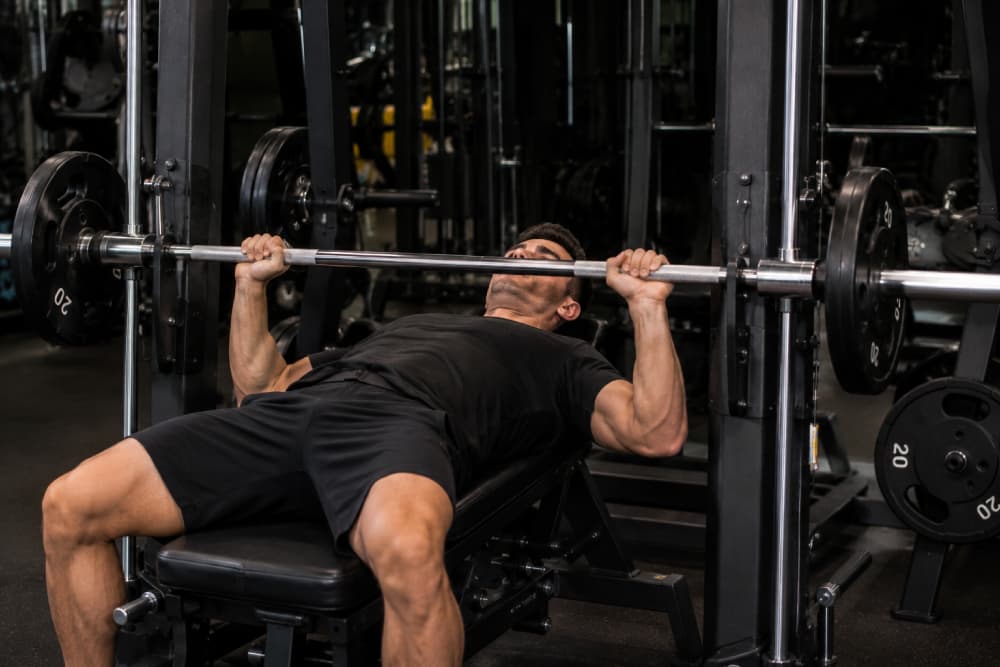
1. Grip width Hands slightly wider than shoulder-width. A useful cue: when the bar is at your chest, your forearms should be vertical (perpendicular to the floor). If your elbows flare wide or your forearms angle inward, adjust your grip.
2. Foot position Feet flat on the floor, directly under your knees or slightly behind them. This creates leg drive — a subtle but important contributor to pressing stability. Never tuck your feet up onto the bench; this eliminates your base.
3. Back position A slight natural arch in the lower back is correct and safe. You should be able to slide a flat hand under your lumbar spine. This is not excessive arching — it’s preserving the natural spinal curve under load.
4. Shoulder blades Retract and depress your shoulder blades before unracking. Think: “pull your shoulder blades into your back pockets.” This creates a stable pressing platform and protects the shoulder joint. Lose this position and you lose the lift’s safety.
5. Bar path The bar does not travel straight up and down. It moves in a slight arc — touching your chest at approximately nipple height, then pressing back and slightly toward your face as you lock out. This is the biomechanically efficient path.
The Press
- Unrack the bar with straight arms, position it directly over your lower chest.
- Take a breath and brace your core (Valsalva maneuver — fill your belly with air, not your chest).
- Lower the bar slowly over 2–3 seconds, keeping your elbows at roughly 45–75 degrees from your torso (not flared to 90 degrees).
- Touch the bar lightly to your chest — don’t bounce it off your sternum.
- Drive the bar upward explosively while maintaining your back arch and shoulder blade position.
- Exhale at the top.
When to Use a Spotter
Always use a spotter when training near your maximum. If training alone, use dumbbells instead of a barbell, or use a power rack with safety bars set just below chest height.
Bench Press Variations for Nomads
1. Flat Barbell Bench Press
The standard. Best for overall chest development and maximum load potential. Available in virtually every commercial gym globally.
Best for: Primary chest development, strength building.
2. Incline Barbell Bench Press (30–45 degrees)
Shifts emphasis to the upper chest and clavicular head of the pectorals. The upper chest is often underdeveloped and contributes significantly to the “flat chest” appearance that comes from desk posture.
Best for: Upper chest development, addressing postural imbalances.
3. Dumbbell Bench Press
Greater range of motion than the barbell — your hands can travel slightly past the plane of your chest, increasing the stretch on the pectorals. Also trains each side independently, reducing strength asymmetries.
Best for: Nomads training alone (no spotter needed — you can drop the dumbbells safely), addressing left-right imbalances.
4. Incline Dumbbell Press
Combines the benefits of incline pressing with dumbbell independence. One of the best upper chest exercises available.
Best for: Upper chest emphasis with safer solo training.
5. Floor Press
No bench? No problem. Lie on the floor, perform the press with dumbbells. The floor naturally limits range of motion (eliminating the bottom stretch), which reduces shoulder stress — making it an excellent option for anyone with shoulder discomfort.
Best for: Hotel room workouts, gyms with limited equipment.
Training Program: Three Phases
Phase 1: Foundation (Weeks 1–4)
Goal: Learn technique, establish baseline strength
- Frequency: 2x per week
- Exercise 1: Flat Dumbbell Bench Press — 3 sets × 12–15 reps
- Exercise 2: Incline Dumbbell Press — 3 sets × 12 reps
- Tempo: 3 seconds down, 1 second pause at chest, 2 seconds up
- Load: Light to moderate — prioritize feeling the chest work
- Rest: 90 seconds between sets
Key cue: At the bottom of each rep, feel a stretch across your chest. If you don’t feel it, your shoulder blades aren’t retracted or your grip is too narrow.
Phase 2: Strength Building (Weeks 5–12)
Goal: Progressive overload, build real pressing strength
- Frequency: 2x per week
- Exercise 1: Flat Barbell Bench Press — 4 sets × 6–10 reps
- Exercise 2: Incline Dumbbell Press — 3 sets × 10–12 reps
- Exercise 3: Dumbbell Flye — 3 sets × 12–15 reps (light, focus on stretch)
- Tempo: 3 seconds down, explosive up
- Load: Increase by 2.5–5kg every 2 weeks when all reps are completed with clean form
- Rest: 2–3 minutes between heavy sets
Phase 3: Travel Maintenance (Anytime)
Goal: Maintain chest strength during unpredictable travel periods
- Exercise 1: Dumbbell Bench Press (or Floor Press) — 3 sets × 12 reps
- Exercise 2: Incline Dumbbell Press — 3 sets × 10 reps
- Rest: 90 seconds
Even one session per week at moderate intensity is enough to prevent significant strength loss during extended travel.
Pairing the Bench Press With Your Full Program
The Push-Pull Balance
The bench press is a pushing movement. For every pushing session, you need an equal volume of pulling — rows, pull-ups, lat pulldowns. Neglecting this ratio is the fastest way to worsen the rounded-shoulder posture you’re trying to fix.
Sample weekly structure for nomads:
| Day | Session |
|---|---|
| Monday | Push (Bench Press + Shoulders + Triceps) |
| Wednesday | Pull (Rows + Lat Pulldown + Bicep Curls) |
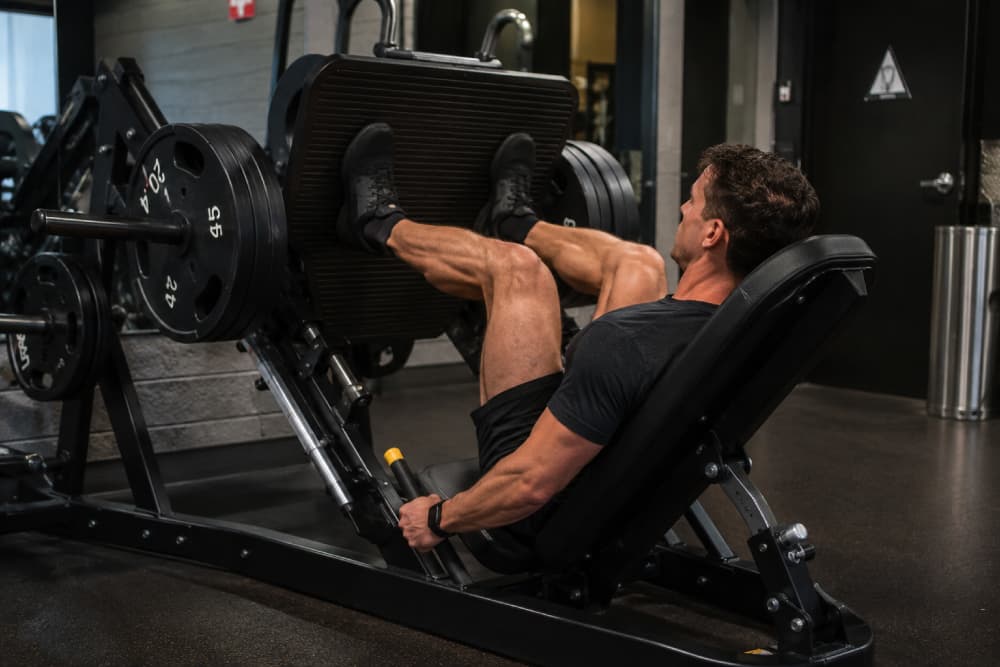
| Friday | Legs (Leg Press + Romanian Deadlift) |
For the leg session, our complete leg press guide for digital nomads covers everything you need.
Frequency
2x per week chest training is optimal for most non-competitive lifters. The chest recovers in 48–72 hours, so spacing sessions with at least two days between them maximizes the stimulus-recovery-adaptation cycle.
Nutrition to Support Your Press
Protein
Muscle repair and growth require adequate protein. Target 1.6–2.0g per kg of body weight daily — the range validated by a landmark meta-analysis in the British Journal of Sports Medicine (2018). For a 75kg person, that’s 120–150g of protein per day.
Creatine
One of the most researched supplements in sports science. A 2017 review in the Journal of the International Society of Sports Nutrition confirmed creatine monohydrate significantly improves strength output in compound pressing movements. 3–5g daily, no loading phase required. Cheap, widely available, and genuinely effective.
Carbohydrates Before Training
Contrary to some low-carb fitness content, carbohydrates are your muscles’ preferred fuel source for high-intensity strength training. A small meal with 30–50g of carbs 60–90 minutes before training meaningfully improves session performance.
Signs the Bench Press Is Working
After 6–8 consistent weeks, expect to notice:
- Visibly fuller chest — the pectorals respond quickly to progressive overload, particularly in beginners and those returning after a break
- Shoulders sitting further back — strengthening the chest through full range of motion, combined with rowing work, begins to counteract the forward pull of desk posture
- Less shoulder discomfort — a stronger serratus anterior and rotator cuff stabilizer system reduces the low-grade ache many nomads carry in their shoulders
- Easier overhead tasks — lifting luggage into overhead bins, reaching high shelves, carrying backpacks all become noticeably more comfortable
- Improved push-up performance — if you test your push-ups after 8 weeks of bench pressing, the improvement will be significant
Closing: The Exercise Your Posture Has Been Waiting For
Digital nomads invest in the best tools for their work: fast laptops, noise-canceling headphones, ergonomic peripherals. But the tool that takes the most abuse — the body that carries all of it — often gets the least attention.
The bench press isn’t about building an impressive physique for its own sake. It’s about building a chest and shoulder complex strong enough to counteract what laptop life does to you every single day. It’s about walking through airports without your shoulders caving forward. It’s about sitting at a desk for eight hours and still having the postural endurance to hold yourself upright by the end of it.
Two sessions per week. One exercise that’s available in every gym on earth. Results that show up both in the mirror and in how you carry yourself through the world.
The bar is waiting.
This article is for informational purposes only and does not replace professional medical advice. If you have a history of shoulder, elbow, or wrist injuries, consult a physiotherapist before beginning any new pressing program.