You’ve just flown 14 hours, sat in a coworking space for 8 hours, then collapsed onto a hostel mattress. Tomorrow, repeat. Your body has been sending distress signals for a while now — and most people ignore them until it’s too late.
Your Body Was Not Built for the Way You Live
There’s a deep irony in the digital nomad lifestyle: you’re free to go anywhere, yet your body is locked into the same position — hunched, seated, screen-gazing.
Research published in the Journal of Physical Activity and Health found that workers who sit for more than 8 hours a day have an early mortality risk comparable to smokers. Even more alarming, a 2021 study in the European Journal of Preventive Cardiology showed that light exercise alone doesn’t fully neutralize the damage caused by prolonged sitting — you need structured strength training.
For digital nomads, the problem compounds:
- Dead glutes — extended sitting causes gluteal amnesia, a condition where your glute muscles literally forget how to fire.
- Tight hip flexors — the muscles at the front of your hips shorten and pull your spine into excessive lordosis.
- Weak hamstrings — a leading contributor to lower back pain, the number-one complaint among remote workers.
- Collapsed posture — without a strong lower body, the spine loses its foundational stability.
No single exercise fixes everything. But if you could only choose one movement to start? The leg press is your answer.
If you’re looking for a complete fitness framework first, check out our fitness routine guide for digital nomads in Canggu, Bali.
Why Leg Press — Not Squats, Not Lunges?
This isn’t about what’s “scientifically optimal.” It’s about what’s realistic for your life.
Squats are great — but they demand a foundation
The barbell back squat is the king of compound movements. But doing it correctly requires solid ankle mobility, reasonably loose hip flexors, and technique built over weeks of practice. Walking into an unfamiliar gym in Chiang Mai after a 6-hour flight and loading a barbell squat? That’s a recipe for injury.
Leg press delivers comparable results with far less risk
A study in the Journal of Strength and Conditioning Research found that the leg press activates the quadriceps, glutes, and hamstrings at levels comparable to the squat — while placing significantly less compressive force on the spine. For someone who already carries a spinal load from sitting all day, that’s not a minor detail.
Why leg press wins for digital nomads:
| Factor | Leg Press | Barbell Squat |
|---|---|---|
| Learning curve | Low — masterable in one session | High — takes weeks to do safely |
| Risk of poor technique | Low | High, especially when fatigued |
| Consistency across gyms | Very high — nearly every gym has one | Depends on rack and barbell availability |
| Suitable after long travel | Yes | Not recommended |
| Can train solo | Yes | Ideally needs a spotter |
The Anatomy of a Leg Press: Why This Movement Changes Everything
When you push against the leg press platform, you’re not just “strengthening your legs.” You’re triggering a neuromuscular adaptation response that reawakens systems long dormant from a sedentary lifestyle.
Quadriceps (Front of the thigh)
The four muscles that make up the anterior thigh — rectus femoris, vastus lateralis, vastus medialis, vastus intermedius. These weaken significantly in people who sit a lot, and quad weakness is directly linked to knee pain and joint instability.
Glutes (Buttocks)
The gluteus maximus is the largest muscle in the body — and the most neglected by digital nomads. Strong glutes aren’t just aesthetic; they’re about pelvic stability, back pain reduction, and efficient movement in daily life.
Hamstrings (Back of the thigh)
Often overshadowed by the quads, the hamstrings act as antagonists that stabilize the knee. Quad-to-hamstring strength imbalance is one of the leading causes of anterior knee injuries.
Core Stabilizers
Despite looking like a “passive” exercise, the leg press activates the transverse abdominis and erector spinae to stabilize your position throughout the movement. You’re also training your core isometrically.
Proper Technique: A Complete Guide from Scratch
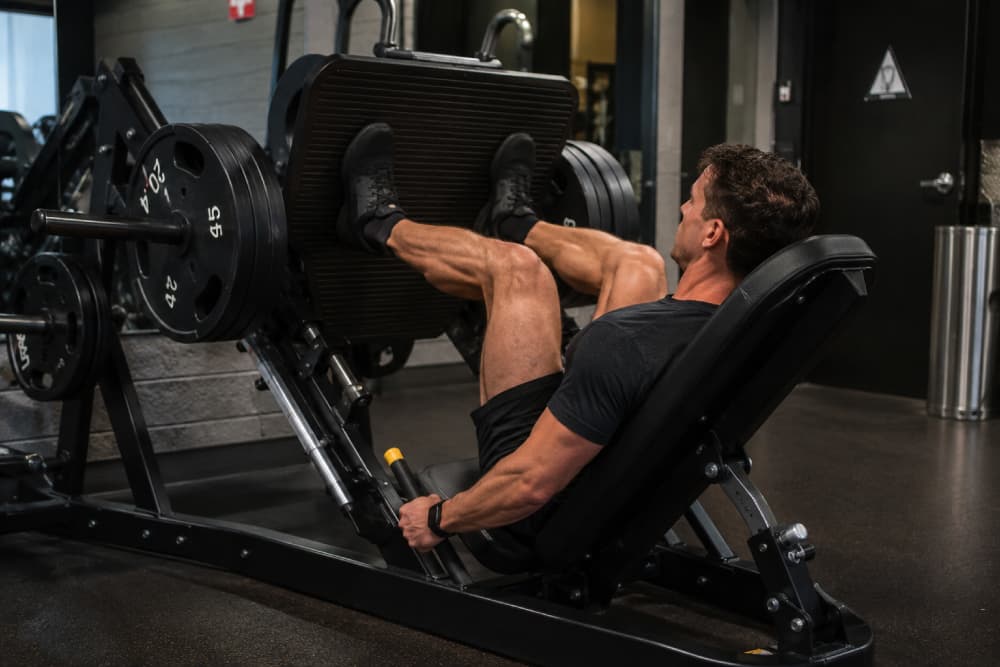
Machine Setup
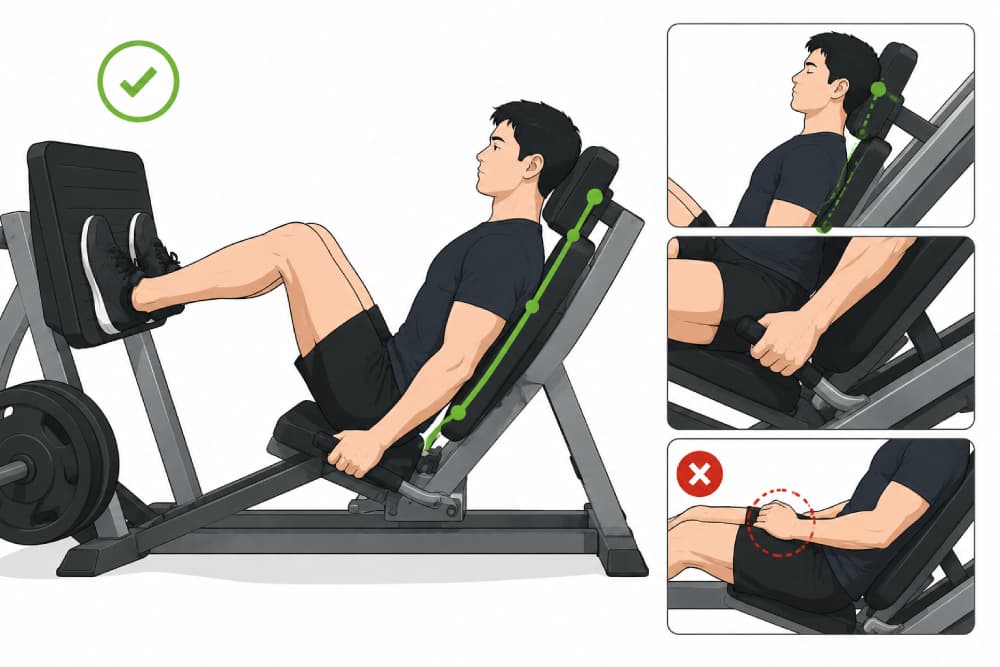
- Back position — your entire back should be in full contact with the pad, especially the lower back. If there’s a gap, adjust the seat angle.
- Head position — let the headrest support you, keep your neck relaxed. Never crane your head forward as you push.
- Hand position — hold the side handles. Never push your hands against your thighs — that’s a compensation sign that the weight is too heavy.
Foot Position: This Changes Which Muscles Work
This is the part most people skip, but it’s critical:
- Shoulder-width, center of platform → balanced activation across all muscle groups
- Higher on platform → more glutes and hamstrings (ideal if your quads tend to dominate)
- Lower on platform → more quad emphasis (but greater knee stress — not recommended for beginners)
- Wider stance → inner quad and adductors more active
- Narrower stance → outer quad more active
Starting recommendation: shoulder-width apart, middle of the platform.
Range of Motion
Lower the platform until your knees form approximately a 90–100 degree angle. Don’t go deeper than what feels comfortable — everyone’s hip mobility differs. The key cue: your hips should not lift off the seat at the bottom (that signals you’ve passed your mobility limit).
Eccentric vs. Concentric Phase
- Lower for 3 seconds — this phase matters just as much as the push. Multiple studies confirm that eccentric loading builds strength and muscle mass more effectively than concentric alone.
- Push for 1–2 seconds — powerful but controlled.
- Never lock out your knees — stop 5–10 degrees before full extension. Locked knees under load is a long-term joint problem waiting to happen.
Training Program: From Zero to Strong
Phase 1: Building the Foundation (Weeks 1–4)
Goal: Learn the technique, wake up dormant muscles
- Frequency: 2x per week
- Sets: 3
- Reps: 15–20
- Tempo: 3 seconds down, 1 second up
- Load: Light — focus on feel, not numbers
- Rest: 90 seconds between sets
What you should feel: pressure through your heels (not your toes), quads firing above the knee, glutes “switched on” at the bottom position.
Phase 2: Building Strength (Weeks 5–12)
Goal: Progressive overload, build functional strength
- Frequency: 2x per week
- Sets: 4
- Reps: 8–12
- Tempo: 3 seconds down, 1 second pause, 2 seconds up
- Load: Increase by 5–10% every two weeks if your last reps still hold good form
- Rest: 2 minutes between sets
Phase 3: Maintenance & Travel Mode (Anytime)
Goal: Preserve strength when your schedule is unpredictable
When you’re in a new city and unsure about the gym situation, use this protocol:
- Sets: 3
- Reps: 12–15
- Load: Moderate, comfortable
- Rest: 60 seconds
Even 20 minutes of leg press is enough to maintain the adaptations you’ve already built.
Fitting This Into an Unpredictable Nomad Life
The “Gym Scouting” Strategy
When you arrive in a new city, spend 30 minutes on your second day (not the first — give your body time to recover from travel) doing this:
- Search Google Maps for “fitness center” or “gym” near your accommodation
- Gyms across Southeast Asia and Eastern Europe commonly offer day passes or weekly passes at very affordable rates
- Confirm they have a leg press machine — virtually every commercial gym does
A Realistic Schedule
Don’t aim for 5x a week. For digital nomads, 2 consistent sessions per week will always outperform 5 sporadic ones. Schedule them like important client meetings — block them in your calendar, non-negotiable.
Pair It With Daily Habits
Leg press isn’t a standalone fix. For maximum results:
- Every hour: Stand for 5 minutes, walk to the window or outside
- Morning or evening: 10 minutes of hip flexor stretching (low lunge, pigeon pose)
- Daily target: 8,000 steps — in walkable cities like Lisbon, Barcelona, or Kyoto, this happens naturally while exploring
- Nutrition: Aim for at least 1.6g of protein per kg of body weight — a meta-analysis in the British Journal of Sports Medicine confirms this as the threshold for muscle protein synthesis
Signs Your Body Is Starting to Recover
After 4–6 weeks of consistency, watch for these shifts:
- Less lower back pain — your glutes and hamstrings begin to share the load that your vertebrae have been absorbing alone
- Less stiffness after long sitting sessions — hip flexors regain elasticity, posture improves organically
- Lighter, easier movement — stronger quads make climbing stairs, walking through new cities, and light trekking noticeably easier
- Better mental focus — this isn’t a stretch: research in Neuroscience & Biobehavioral Reviews confirms a direct link between skeletal muscle strength and cognitive function, particularly memory and executive performance
Closing: A 40-Minute Investment That Changes Everything
The digital nomad lifestyle gives you extraordinary freedom — but that freedom carries a hidden cost paid by your body. Every kilometer traveled, every hour at the laptop, every night on a different mattress — it all leaves a mark.
Leg press isn’t about building an ideal physique. It’s about maintaining a functional one — a body capable of hiking to the best viewpoint in Madeira, cycling through Kyoto, walking 20,000 steps through Istanbul, and still showing up sharp at the laptop the next morning.
Two sessions a week. One machine found in almost every gym on earth. Results that compound for a lifetime.
You’ve already invested in the best laptop, the best camera, the best internet connection for your career. It’s time to make the same investment in the most important machine you own: your body.
This article is for informational purposes only and does not replace professional medical advice. If you have a history of knee, hip, or back injuries, consult a physiotherapist before starting any new training program.