

Hyrox has exploded in popularity worldwide — eight stations, a 1km run between each one, and a finish line that rewards the athletes who trained their engine as seriously as their strength. There isn’t a Hyrox box in Bali yet. That doesn’t mean you can’t show up on race day ready to compete.
What Hyrox Actually Demands From Your Body
Hyrox isn’t a CrossFit competition and it isn’t a marathon. It’s something in between — a race that punishes anyone who’s only trained one energy system.
The format is fixed and identical at every Hyrox event worldwide: 8km of running, broken into 1km segments, alternating with 8 functional stations:
- SkiErg — 1000m
- Sled Push — 50m
- Sled Pull — 50m
- Burpee Broad Jumps — 80m
- Rowing — 1000m
- Farmers Carry — 200m
- Sandbag Lunges — 100m
- Wall Balls — 100 reps
What makes Hyrox brutal isn’t any single station — it’s that you’re doing all of this on legs that have already run 7km by the time you reach the wall balls. Pure strength athletes who’ve never built an aerobic engine fall apart on the runs. Pure endurance athletes who’ve never trained heavy carries and sled work fall apart on the stations. Hyrox rewards the athlete who’s genuinely trained both.
Why “No Hyrox Box Nearby” Isn’t the Obstacle You Think It Is
A lot of people assume they need access to an official Hyrox training facility — with a full station layout and simulated race setups — to prepare properly. In reality, most Hyrox stations map directly onto equipment and movements available in any well-equipped strength gym. You don’t need to simulate the whole race to build the specific fitness it demands. You need to train the individual qualities — strength, aerobic capacity, and muscular endurance under fatigue — and put them together closer to race day.
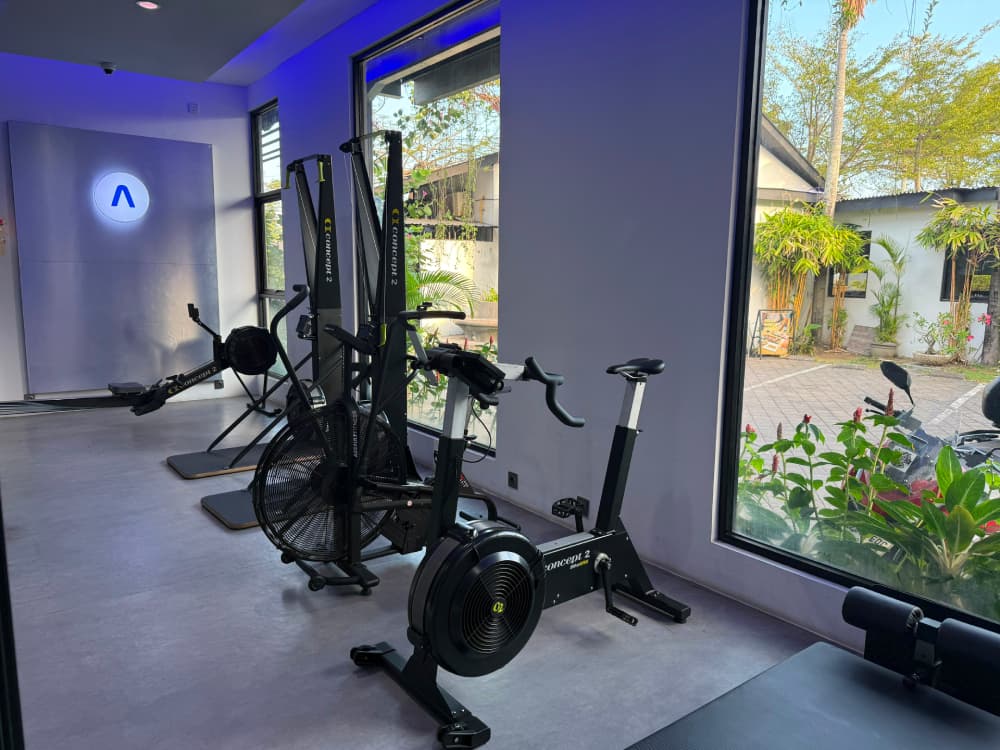
Avenue Fitness Bali, in Canggu, isn’t a Hyrox-branded box, but it has the two pieces of equipment that matter most for engine-building — a SkiErg and a Concept 2 rower — alongside a full strength setup covering everything else on the station list.
The Two Machines That Make the Biggest Difference
SkiErg
The SkiErg is a near-exact replica of the first Hyrox station, and it’s one of the most underrated tools for building total-body conditioning. It trains the lats, triceps, core, and hip hinge simultaneously while demanding serious cardiovascular output — making it one of the most specific pieces of equipment you can train on outside of race day itself.
Most people who’ve never used a SkiErg dramatically underestimate how much it fatigues the upper body and core, not just the arms. Building comfort and pacing on this machine specifically is one of the highest-leverage things you can do in Hyrox prep, because it’s the very first thing you’ll face on race day — with fresh legs but a nervous system that’s about to spend the next hour under load.
Concept 2 Rower
The rower is Hyrox’s fifth station, arriving after you’ve already run 4km and pushed/pulled a sled and done burpee broad jumps. Training on the Concept 2 isn’t just about rowing fitness in isolation — it’s about practicing what good rowing technique looks like when your legs are already fatigued, since that’s the exact state you’ll be in during the race.
Both machines allow you to train two of the eight Hyrox stations with genuine specificity, which is a significant head start compared to trying to approximate them with substitute movements.
Building Your Hyrox Engine: Training the Three Qualities
1. Aerobic Base (The Foundation)
Before intervals, before race simulations, you need a genuine aerobic base — the capacity to sustain moderate effort for long periods without your heart rate spiking into the red.
- 2–3x per week: 30–40 minutes of steady-state SkiErg or rowing at a conversational pace (roughly 60–70% of max effort)
- This should feel sustainable, not exhausting. If you can’t hold a conversation in short sentences, you’re going too hard.
- Build duration gradually over 4–6 weeks before introducing high-intensity intervals.
2. Strength (The Power Behind Every Station)
Every Hyrox station has a strength component hiding inside an endurance format. Sled work, farmers carries, lunges, and wall balls are all fundamentally strength movements performed under fatigue — meaning your baseline strength ceiling determines how much you have left to give when your legs are already burning.
- Lower body: squats, leg press, Romanian deadlifts, walking lunges — building the quad, glute, and hamstring strength that carries you through sled pushes, lunges, and burpee broad jumps
- Upper body / pulling: rows, lat pulldowns — the pulling strength that directly transfers to sled pulls and farmers carries
- Core and full-body: heavy carries, weighted planks — the trunk stability every station demands to keep form intact under fatigue
Train strength 2–3x per week, separate from your conditioning sessions where possible, especially early in a training block.
3. Muscular Endurance Under Fatigue (The Race-Specific Piece)
This is what makes Hyrox unique, and it’s the quality most general fitness programs neglect entirely: the ability to perform strength movements well after your legs and cardiovascular system are already taxed.
- Once your aerobic base and strength foundation are established (typically 6–8 weeks in), start combining them: a short run followed immediately by a strength station, repeated for multiple rounds.
- Example: 1km SkiErg → 20 walking lunges → 1km row → 15 wall balls → repeat for 3–4 rounds.
- This is where race simulation becomes valuable — but only after the base qualities are built. Doing this too early just reinforces poor technique under fatigue instead of building genuine capacity.
A Sample 12-Week Structure
Weeks 1–4: Base Building
- 2x aerobic sessions (SkiErg or rower, steady state)
- 2x strength sessions (full body, moderate load, higher reps)
- 1x mixed movement session (lighter weights, focus on technique for lunges, wall balls, farmers carries)
Weeks 5–8: Building the Engine
- 2x aerobic sessions, now including some interval work (e.g., 5 x 500m SkiErg with short rest)
- 2x strength sessions, progressing load
- 1–2x combined sessions pairing short conditioning bursts with strength stations
Weeks 9–12: Race-Specific Prep
- 1–2x longer aerobic sessions
- 1–2x strength sessions, maintaining load, reducing volume slightly
- 2x race-simulation sessions — running segments paired with station work, progressively closer to actual Hyrox distances and rep counts as race day approaches
Nutrition and Recovery for Hybrid Training
Training both strength and endurance simultaneously — often called “hybrid” or “concurrent” training — places a higher recovery demand on your body than training either quality alone.
Protein. Target 1.6–2.0g per kg of body weight daily to support both muscle repair from strength work and recovery from conditioning sessions.
Carbohydrates. Don’t under-fuel this kind of training. Aerobic and interval sessions burn through glycogen quickly, and under-fueling leads to flat sessions and slower recovery. Prioritize carbohydrates around your hardest training days.
Sleep. Concurrent training is demanding on the nervous system. 7–9 hours of sleep isn’t optional here — it’s the difference between adapting to the training load and just accumulating fatigue.
Deload Weeks. Every 4th week, reduce volume by roughly 30–40% across both strength and conditioning sessions. Hybrid training without planned deloads is one of the most common ways people burn out mid-training-block.
What This Actually Looks Like at the Gym
A realistic training week combining what’s outlined above:
| Day | Focus |
|---|---|
| Monday | Strength (lower body: squats, leg press, lunges) |
| Tuesday | SkiErg steady state or intervals |
| Wednesday | Strength (upper body: rows, pulldowns, carries) |
| Thursday | Concept 2 row steady state or intervals |
| Friday | Combined session (short run/erg + station work) |
| Saturday | Optional: longer aerobic session or active recovery |
| Sunday | Rest |
You Don’t Need a Box, You Need a Plan
Hyrox rewards preparation, not proximity to an official training facility. The race is built from movements and energy systems you can train anywhere with the right equipment and a program that respects both strength and endurance — not just one or the other.
A SkiErg, a Concept 2 rower, and a proper strength setup cover the vast majority of what race day demands. The rest comes down to consistency and a training plan that builds the base before it asks for race-specific output.
If you’re in Canggu and training for Hyrox, Avenue Fitness Bali has the SkiErg, Concept 2 rower, and full strength equipment to build the engine and the strength race day demands — check out membership options here.
This article is for informational purposes only and does not replace professional medical or coaching advice. If you’re new to high-intensity training or have any underlying health conditions, consult a physician before beginning a Hyrox training program.