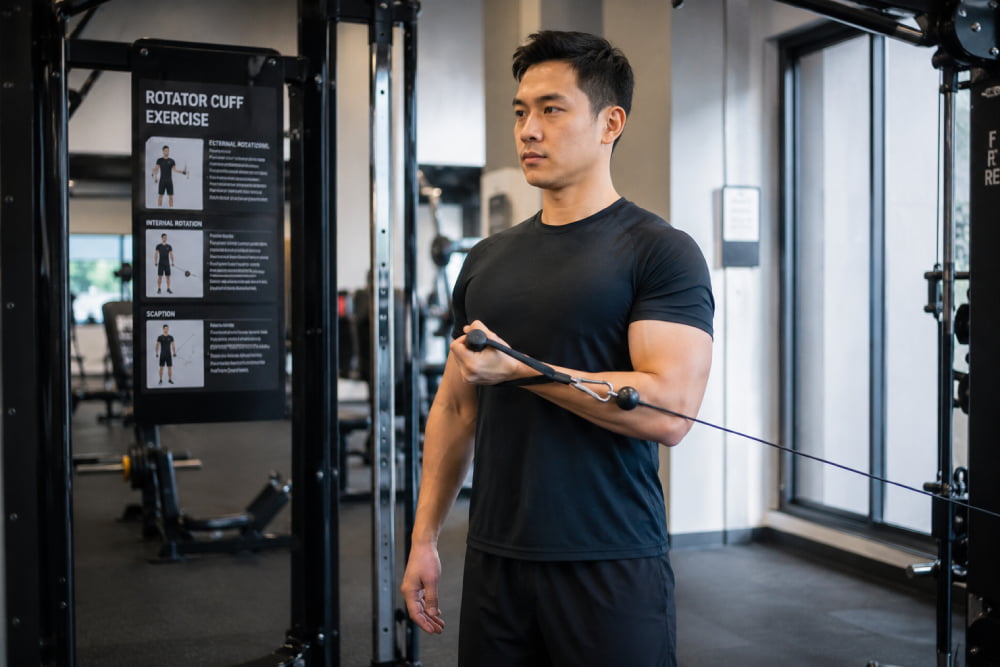
Quick Summary: What are the best rotator cuff exercises for shoulder health?
The most effective movements to build strength, ensure shoulder stability, and promote shoulder impingement prevention include:
- Resistance Band External Rotation: Builds stabilizing strength in the infraspinatus and teres minor.
- Cable Internal Rotation: Targets the subscapularis for balanced power and joint centralization.
- Scaption (Full Can Exercise): Safely isolates the supraspinatus without grinding the joint.
- Side-Lying Dumbbell External Rotation: Uses gravity to provide maximum isolation of the external rotators.
- Cable Face Pulls with External Rotation: Strengthens the posterior chain while training the rotator cuff in a dynamic, functional plane.
Introduction: The Hidden Heroes of Heavy Lifting
Whether you are reaching for a heavy box on a top shelf, swinging a tennis racket, or setting up for a new personal record on the barbell bench press, your shoulder joint is working overtime. However, the true heroes behind these movements aren’t your massive deltoids or pecs—they are a group of small, deeply set muscles collectively known as the rotator cuff.
As a sports physiotherapist, I frequently see gym-goers sideline their progress due to preventable shoulder pain. We spend hours building the “mirror muscles” but often neglect the stabilizing structures underneath. Incorporating dedicated rotator cuff exercises into your routine isn’t just about injury rehabilitation; it is a foundational strategy for performance enhancement. By securing the joint, your central nervous system feels safe enough to recruit more muscle fibers, instantly improving your strength output on major lifts.
Let’s dive into the anatomy of the shoulder and outline the exact exercises you need to build resilient, pain-free shoulders.
The Anatomy: Why is the Rotator Cuff the “Weak Link”?
The shoulder is a ball-and-socket joint, but unlike the deep socket of the hip, the shoulder’s socket is incredibly shallow—often compared to a golf ball sitting on a tee. This design grants us an incredible, multi-directional range of motion, but it comes at a steep cost: a severe lack of inherent stability.
To keep the “golf ball” centered on the “tee” during movement, the body relies on four small muscles, easily remembered by the acronym SITS:
- Supraspinatus: Initiates the lifting of the arm away from the body (abduction).
- Infraspinatus: Primarily responsible for external rotation.
- Teres Minor: Works alongside the infraspinatus to externally rotate the arm.
- Subscapularis: The largest of the four, resting on the front of the shoulder blade, responsible for internal rotation.
Because these muscles are small, they are easily overpowered by the larger chest and back muscles. When this strength imbalance occurs, the head of the humerus (arm bone) can drift off-center, pinching tendons and causing inflammation. This makes the rotator cuff the structural “weak link” for many fitness enthusiasts.
5 Best Rotator Cuff Exercises for Maximum Stability
To ensure balanced shoulder health, you need to train all functions of the SITS muscles. Here are the five best movements to add to your routine.
1. Resistance Band External Rotation
This is the gold standard of resistance band shoulder exercises, specifically targeting the infraspinatus and teres minor to combat the rounded-shoulder posture caused by desk work and heavy pressing.
- How to do it: Anchor a light resistance band at elbow height. Stand perpendicular to the anchor point, holding the band with your outside hand. Keep your elbow pinned to your side at a 90-degree angle. Slowly rotate your forearm outward, pulling the band away from your body. Slowly return to the starting position.
- Equipment needed: Light resistance band or cable machine.
- Common Mistakes: Letting the elbow drift away from the torso, or using momentum to jerk the band.
- Pro Tip: Roll up a small towel and squeeze it between your elbow and your ribcage. If the towel drops, your form has broken down.
2. Cable Internal Rotation
While external rotation gets a lot of attention, internal rotation is equally vital. This targets the subscapularis, which protects the front of the shoulder capsule during heavy pressing movements.
- How to do it: Stand perpendicular to a cable machine set at elbow height, but this time hold the handle with the hand closest to the machine. Keep your elbow tucked at 90 degrees. Rotate your forearm inward across your stomach. Control the weight as it pulls your hand back outward.
- Equipment needed: Cable machine with a D-handle (or a resistance band).
- Common Mistakes: Using too much weight, which forces the larger pectoral muscles to take over the movement.
- Pro Tip: Think about rotating from the shoulder joint itself rather than just moving your wrist and hand across your body.
3. Scaption (Full Can Exercise)
This movement isolates the supraspinatus while avoiding the anatomical pinching often associated with traditional lateral raises, making it a masterclass in shoulder impingement prevention.
- How to do it: Stand holding a very light pair of dumbbells. Instead of raising your arms directly to the side or directly to the front, raise them in the “scapular plane”—roughly a 30-degree angle forward from your sides. Keep your thumbs pointing straight up toward the ceiling (the “full can” position). Raise the dumbbells to shoulder height and lower slowly.
- Equipment needed: Very light dumbbells (2-5 lbs is usually plenty).
- Common Mistakes: Pointing the thumbs down (the “empty can” position), which drastically increases the risk of rotator cuff impingement.
- Pro Tip: Keep your shoulder blades pulled down and back throughout the movement. Shrugging will shift the tension to your upper traps.
4. Side-Lying Dumbbell External Rotation
By lying on your side, you change the strength curve. Gravity now provides maximum resistance exactly where the external rotators are weakest, providing incredible isolation.
- How to do it: Lie on your side on a bench or mat. Hold a light dumbbell in your top hand, resting your elbow securely against your side (90-degree bend). Keeping the elbow pinned, rotate the dumbbell upward toward the ceiling as far as comfortable. Lower it slowly back across your stomach.
- Equipment needed: Flat bench or mat, light dumbbell.
- Common Mistakes: Rolling your torso backward to try and lift the weight higher. Keep your hips and shoulders stacked perfectly vertically.
- Pro Tip: Use an incredibly slow eccentric (lowering) phase—count to 3 or 4 seconds as the weight comes down to build robust tendon resilience.
5. Cable Face Pulls with External Rotation
Face pulls are fantastic for the upper back, but when executed with an emphasis on external rotation at the end of the movement, they become a highly functional rotator cuff strengthener.
- How to do it: Attach a rope to a cable pulley set at upper-chest height. Grasp the rope with your thumbs pointing backward. Pull the rope toward your face, letting your elbows flare outward. As the rope approaches your face, actively externally rotate your shoulders so your hands end up higher than your elbows (striking a “double bicep” pose).
- Equipment needed: Cable machine with a rope attachment.
- Common Mistakes: Using a heavy weight that forces you to use your lower back to yank the cable, entirely bypassing the small shoulder stabilizers.
- Pro Tip: Pause for a full two seconds at the contracted position near your face, actively squeezing your shoulder blades together and pulling your hands back.
Programming & Frequency: Pre-Hab Warm-Up Routine
As a physiotherapist, I recommend programming rotator cuff work as “pre-hab” (preventative rehabilitation) rather than an exhausting finisher. You want these muscles activated and firing properly before you load the barbell.
Perform this circuit 2 to 3 times per week, ideally before your upper body workouts.
| Exercise | Sets | Reps | Rest | Goal Focus |
| Resistance Band External Rotation | 2 | 12-15 / arm | 30s | Activation / Blood Flow |
| Cable Internal Rotation | 2 | 12-15 / arm | 30s | Balance / Subscapularis Activation |
| Scaption (Full Can) | 2 | 10-12 | 45s | Supraspinatus Isolation |
| Face Pulls with Ext. Rotation | 3 | 12-15 | 60s | Posterior Chain Integration |
Note: The side-lying external rotation is best saved for the end of a workout if you are focusing on targeted hypertrophy of the external rotators, as it is highly fatiguing.
FAQ: Your Rotator Cuff Questions Answered
How often should I train my rotator cuff?
For general health and injury prevention, training the rotator cuff 2 to 3 times a week is optimal. Because these are small postural muscles containing a high percentage of slow-twitch muscle fibers, they respond best to high-frequency, low-weight, and moderate-to-high rep ranges (12-20 reps).
Can I lift heavy with a rotator cuff injury?
No. Lifting heavy with a compromised rotator cuff will exacerbate the injury, potentially turning a mild strain or tendinopathy into a full tear. If you experience sharp, stabbing pain or severe weakness, stop heavy pressing immediately and consult a sports physiotherapist. Focus on pain-free rehabilitation exercises before returning to the barbell.
How do I know if my rotator cuff is weak?
Signs of a weak rotator cuff include a dull ache deep in the shoulder joint after working out, a clicking or popping sensation during overhead movements, rounded shoulder posture, or an inability to increase the weight on your bench press despite consistent training. If your shoulder feels “loose” or unstable when holding a weight overhead, your stabilizers need work.
Conclusion
Ignoring the small, stabilizing muscles of your shoulder is a one-way ticket to an injury that could keep you out of the gym for months. By incorporating these five rotator cuff exercises into your weekly routine, you will dramatically improve your shoulder stability, achieve excellent shoulder impingement prevention, and create a strong foundation for lifting heavier weights safely.
Take the next step in your fitness journey at Avenue Fitness. A strong upper body requires stable shoulders. Our gym features specialist equipment often missing from standard facilities, and our trainers can customize a pre-hab plan that integrates seamlessly with your main lifts. Visit Avenue Fitness today to bulletproof your joints and elevate your performance!